
So first it was Facebook that changed its name to Meta, we now have a rebrand for Twitter, changing it’s name to X. Since Elon Musk purchased Twitter in November 2022, his management of the social media site has been marked by a series of upheavals, including his U-turns on the acquisition, firings and re-hirings, and a dramatic decline in advertising revenue. But his most recent action—giving up the name Twitter and renaming the platform X—is the most consequential.
Presentations on rebranding by corporate executives eager to demonstrate how the new image matches with organisational strategy and company vision frequently accompany such major changes.
Twitter users offered the chance to rebrand logo
Musk allowed users to submit a logo design, but in keeping with Twitter’s recent disruptive attitude, no in-depth explanation for the X makeover was provided to company outsiders. Chief executive Linda Yaccarino invited colleagues to “build X” with her and Musk in a widely reported internal memo, but she withheld the specifics of how and why.
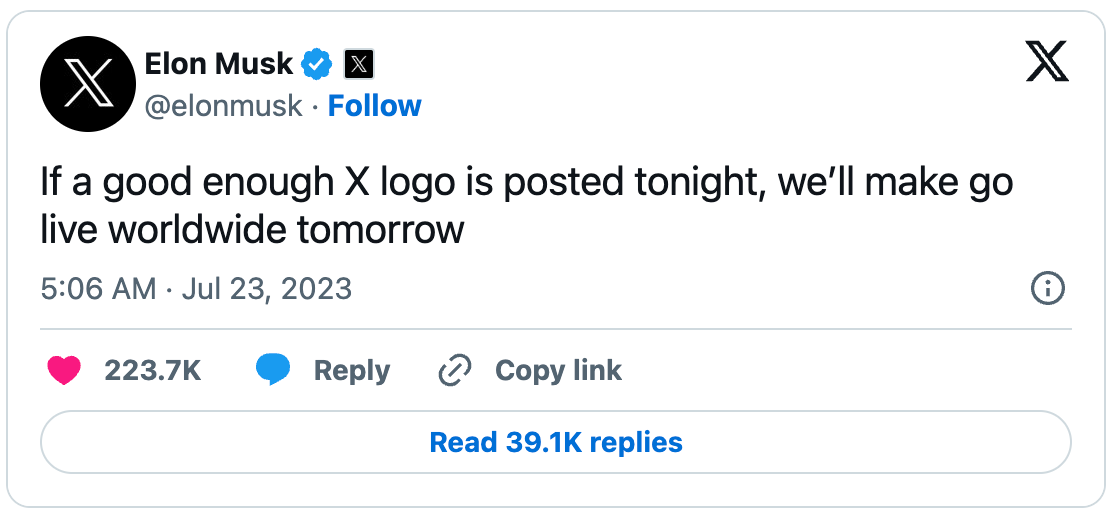
The selection of the X sign was predictable in terms of brand identity. Musk has employed the letter for his technological start-up xAI, engineering firm SpaceX, and now X Corp (he already changed the company’s formal name from Twitter Inc. to X Corp in March 2023).
The character is unique and conveys a feeling of mystery as a symbol. Its general application as a substitute for most things also fits with Musk’s ideas for a “everything app” that provides far more than a means of communication. However, according to marketing studies and the patchy track record of such rebrands, Musk will have to do much more than simply alter Twitter’s name and logo to guarantee that X truly becomes “everything” to its users.
Company Rebrands
In reaction to structural, strategic, and functional reasons, companies frequently modify their brands. A change in administration with a new logo denoting a new direction could be a structural factor. Negative perceptions or associations are commonly used as strategic justifications, as well as signals of activity shifts or shifting customer preferences. A functional justification might stress a brand’s ongoing relevance or optimise logo presentation on new platforms like mobile apps.
The expression of the logo frequently changes more significantly in response to structural and strategic considerations. Early brand logos, like British Telecom’s piper logo, usually express key functions. This pattern has also been used by tech companies like Netflix, whose early logo designs featured a cinema reel.
This makes it simpler for others to comprehend what the business does, which is crucial in the early years of a corporation.
In fact, the Twitter brand logo perfectly encapsulated the essence of the platform—the notion of tweeting out quick thoughts as part of an open discussion. This may be seen in both the bird emblem and the name, which conveys speed through the peculiar consonant mix of “t” and “w” and the user’s ability to “tweet” a brief message.
However, gaining notoriety for a particular endeavour can turn into a liability. A company’s variety of operations may increase as brands develop, and the brand messaging may no longer adequately describe those activities.
While Twitter’s primary function now remains unaltered, Musk’s goal to transform the platform into more than a communication tool is aligned with the redesign. He has frequently mentioned the concept of developing a “everything app” similar to Tencent’s well-known WeChat app in China, which has payment and communication features (much like WhatsApp).
WeChat, which boasts over 1.3 billion monthly active users, demonstrates the potential for fusing online financial transactions (like Paypal) and communication (like Twitter) into a promising future idea: “the global town square for everything.” In other words, a platform that is essential to transactions, communications, and authorisation to the point where it serves as a central hub for all kinds of exchanges.